
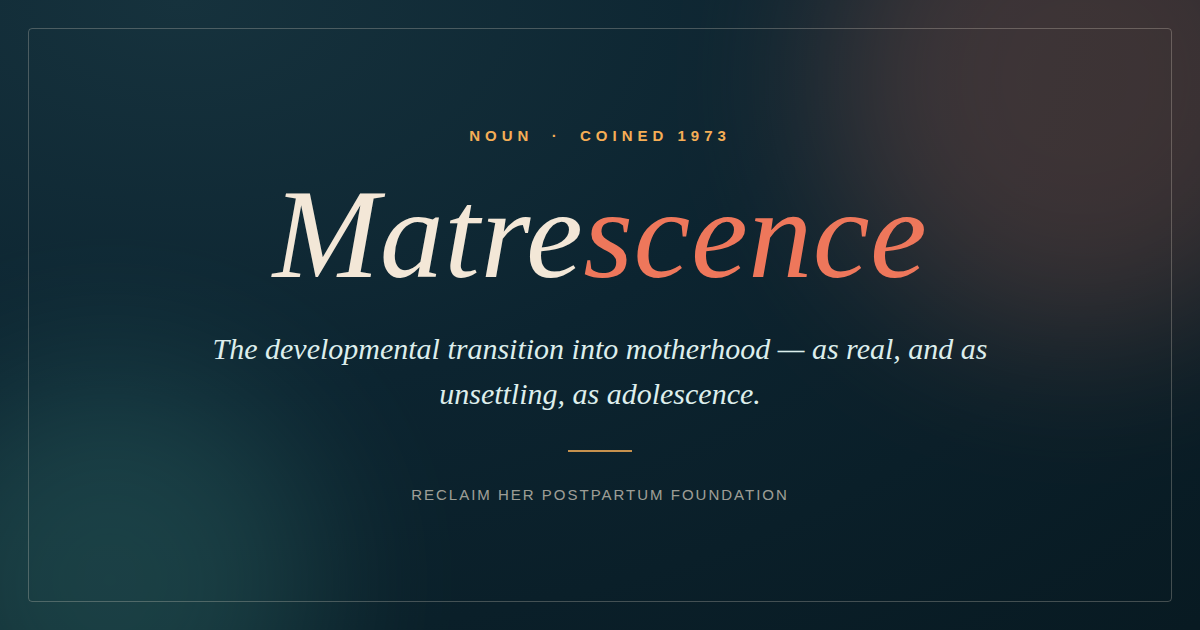
Long before you became a mother, you were something else — a version of yourself with a full night’s sleep, an intact sense of your own name, a body and a mind you mostly recognized. Then your baby arrived, and so did someone new: a mother, still becoming. There’s a word for that becoming. It’s called matrescence, and once you learn it, you may find it explains more of postpartum life than any diagnosis ever could.
What is matrescence?
Matrescence is the developmental transition into motherhood — a shift so total it touches the body, the brain, the identity, the relationships, and even the spirit. The term was coined in 1973 by medical anthropologist Dana Raphael (who also popularized the word “doula”), and it was revived decades later by psychologist Dr. Aurélie Athan of Columbia University, who has spent her career arguing that psychology has paid far more attention to maternal pathology than to maternal development.
Athan frames matrescence as a “bio-psycho-social-cultural-spiritual” transformation that begins in pregnancy (or earlier) and unfolds well beyond the postpartum period. It is not a diagnosis. It is not a disorder. It is a life stage — and it deserves a name mothers can use.
Why compare it to adolescence?
The comparison to adolescence is deliberate, not poetic shorthand. Both are periods of profound hormonal shift, physical change, and identity renegotiation. A teenager’s body and brain are reorganizing around who they’re becoming; a new mother’s body and brain are doing the same. Oxytocin surges reshape bonding at a cellular level. Sleep, hormones, and a completely new set of responsibilities reorganize how a woman experiences herself and her place in the world.
Just as no one expects a 13-year-old to feel emotionally settled overnight, no mother should be expected to feel instantly whole again after birth. The upheaval isn’t a malfunction. It’s the process working as it should.
Why this matters for postpartum care
Here’s the problem: because matrescence has no name in mainstream healthcare, its very real symptoms — fatigue, identity confusion, grief for an old self, ambivalence about the new one, a body that doesn’t yet feel like home — often get filed under “just” hormones, “just” the baby blues, or worse, mistaken entirely for postpartum depression. Recent work in perinatal psychiatry has begun pushing for a strengths-based framework that recognizes matrescence as a normative developmental stage, distinct from (though sometimes overlapping with) clinical postpartum mood disorders. That distinction matters: pathologizing a normal transition can leave mothers feeling broken, while naming it can be the difference between shame and self-understanding.
As Dr. Athan puts it, mothers deserve a “destigmatizing and agentic lens” — language that lets them describe what’s happening to them without immediately reaching for the vocabulary of illness. Ambivalence, she argues, isn’t a red flag. It can be the hallmark of motherhood itself: both stressful and growth-producing, often at the very same moment.
What matrescence can look like
- Grieving the person you were before, even while loving who you’re becoming
- Feeling like a stranger in your own body, long after the six-week check-up
- A shifting sense of identity — in your career, your marriage, your friendships, your body
- Holding pleasure and hardship in the same breath, without either one canceling out the other
- Needing far longer than six weeks to feel like yourself — because matrescence isn’t a milestone you hit, it’s a passage you move through, sometimes for years
How this connects to our mission
This is exactly why Reclaim Her Postpartum Foundation exists. Motherhood is a woman’s rebirth — and rebirth deserves more than a single follow-up appointment. Matrescence isn’t something to fix; it’s something to be supported through, with pelvic floor care, craniosacral therapy, emotional support, and community that treats the whole transition, not just the six weeks after delivery.
If any of this sounds familiar — the exhaustion that isn’t just tiredness, the identity questions no one prepared you for, the body that still doesn’t feel like yours — you are not broken, and you are not alone. You’re in matrescence. And it deserves care.
Explore how Reclaim Her can support you through this transition on our Services and Apply pages.
Sources: Dana Raphael’s original 1973 coinage of “matrescence,” as discussed by The Bump and Welcome Mama; Dr. Aurélie Athan’s framework via Psychology Today and her own writing; perinatal psychiatry framework from Frontiers in Psychiatry (2024).